
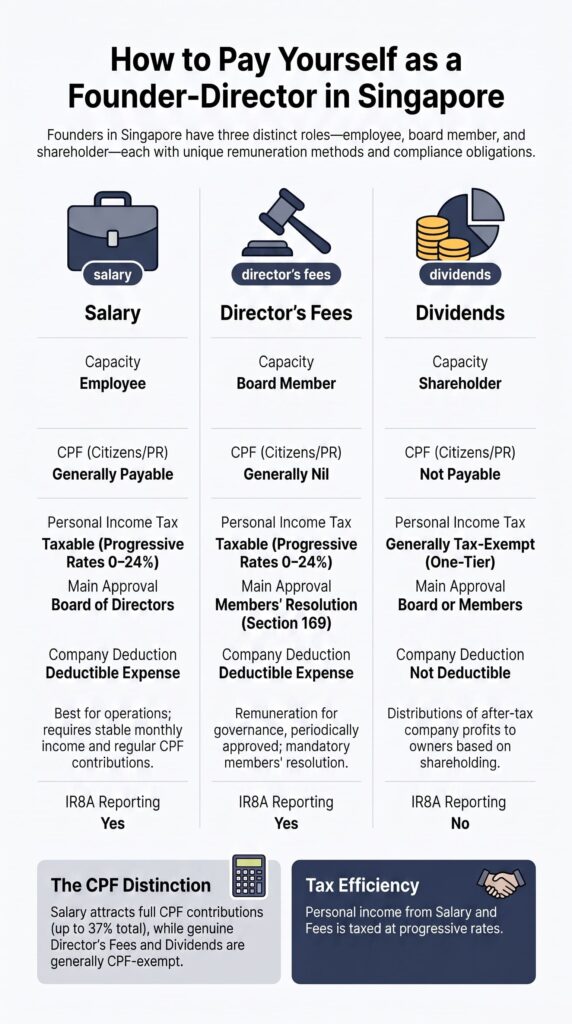
As a director and shareholder of a Singapore company, you may receive money from the company in several different capacities. The payment may be salary for work performed as an employee, director’s fees for serving on the board, or dividends paid to you as a shareholder.
These payments should not be treated interchangeably. Each has its own approval process, CPF treatment, tax implications and accounting requirements.
Transfers from the company’s bank account should therefore have a clear basis and be properly recorded. Moving money to a personal account without identifying whether it is salary, fees, dividends, reimbursement or repayment of a loan can result in incorrect accounts and unnecessary accounting and compliance issues.
This guide explains the three main ways a founder-director may pay themselves through a Singapore company.
Not Every Payment to a Director Is Remuneration
Salary, director’s fees and dividends are not the only reasons a company may transfer money to a director.
For example, a company may also:
- Reimburse a director for business expenses paid personally on behalf of the company
- Repay money that the director previously lent to the company
- Refund an amount paid by the director for company purchases
These are generally balance sheet or expense transactions rather than payment for the director’s services. They should still be supported by invoices, receipts, loan records and other relevant documents.
Important: A director should not treat the company’s bank account as a personal account. Where a transfer is not supported by remuneration, expenses, dividends or repayment of money owed, it may be recorded as an amount due from the director. Loans and other financial assistance provided by a company to its directors may also be subject to restrictions under the Companies Act.
Salary vs Director’s Fees vs Dividends in Singapore
The following provides a general comparison of the three main payment methods.
| Method | Payment Made To You As | CPF | Personal Income Tax | Company Tax Deduction | Main Approval |
|---|---|---|---|---|---|
| Salary | An employee | Generally payable for Singapore Citizens and PRs employed under a contract of service | Taxable | Generally deductible | Board-approved employment arrangement |
| Director’s fees | A member of the board | Generally not payable on genuine director’s fees approved by members | Taxable | Generally deductible when properly incurred and accrued | Members of the company |
| Dividends | A shareholder | Not payable | Generally tax-exempt for one-tier dividends | Not deductible | Board or members, depending on the type of dividend and the company’s Constitution |
The tax treatment above assumes that the individual is a Singapore tax resident. Different rules may apply to non-resident directors, including possible withholding tax obligations.
Method 1: Pay Yourself a Salary
A director may also be employed by the company to carry out executive or operational work. For example, the director may serve as the company’s managing director, chief executive officer, sales director or operations manager.
In this situation, the director is usually engaged under an employment contract and receives a salary for work performed as an employee. This is separate from holding office as a member of the board.
The employment terms and remuneration should be properly approved and documented. The company should also maintain the usual payroll records, payslips and employment income reporting.
CPF contributions
Where the director is a Singapore Citizen or Permanent Resident employed under a contract of service, CPF contributions are generally payable on the salary and other wages received.
The applicable CPF rate depends on:
- The employee’s age
- The amount of wages paid
- The Ordinary Wage and Additional Wage ceilings
- Whether a Permanent Resident is in the first, second or third year of SPR status
- Whether the employer and employee have applied to contribute at higher rates
From 1 January 2026, the full CPF contribution rates for Singapore Citizens and third-year onwards Permanent Residents earning monthly wages above S$750 are:
| Employee’s Age | Employer Contribution | Employee Contribution | Total Contribution |
|---|---|---|---|
| 55 and below | 17% | 20% | 37% |
| Above 55 to 60 | 16% | 18% | 34% |
| Above 60 to 65 | 12.5% | 12.5% | 25% |
| Above 65 to 70 | 9% | 7.5% | 16.5% |
| Above 70 | 7.5% | 5% | 12.5% |
The CPF Ordinary Wage ceiling is S$8,000 per month from 1 January 2026. Additional Wages, such as bonuses, are subject to the applicable annual Additional Wage ceiling.
Example: A Singapore Citizen aged 55 or below receives a monthly salary of S$5,000. The company contributes S$850 as the employer’s CPF portion. S$1,000 is deducted from the employee’s salary as the employee’s CPF portion. The company’s total monthly salary cost is therefore S$5,850, before other employment costs.
CPF contributions are not payable for an employee who is neither a Singapore Citizen nor a Permanent Resident.
View the CPF contribution rate tables effective from 1 January 2026.
Personal income tax
Salary is taxable employment income.
For a Singapore tax resident, it is taxed at the prevailing progressive personal income tax rates. The current resident rates range from 0% on the first S$20,000 of chargeable income to 24% for the highest income band.
The actual tax payable is based on the individual’s total chargeable income after taking into account applicable deductions and reliefs. It is not calculated solely on the salary received from the company.
Company tax deduction
Salary and employer CPF contributions are generally deductible expenses for the company where they are incurred wholly and exclusively in producing the company’s income.
The amount should be commercially supportable and properly recorded through the company’s bookkeeping and payroll records. Unusually high remuneration paid to a related party without a clear commercial basis may be questioned.
When salary may be suitable
- The director works full-time or regularly in the company’s operations
- A stable monthly income is required
- The director wishes to make regular CPF contributions
- Payslips and employment income records may be useful for a mortgage or loan application
- The company already operates a regular payroll system
Points to consider
- Employer CPF increases the company’s employment cost
- A fixed salary creates an ongoing monthly cash-flow commitment
- Payroll, CPF and annual employment income reporting must be completed correctly
Method 2: Pay Yourself Director’s Fees
Director’s fees are paid to a person for serving in the office of director. They relate to the director’s board responsibilities, oversight, decision-making and governance duties.
This should be distinguished from salary paid for operational work carried out under an employment arrangement.
Classification matters: A monthly payment for carrying out the company’s day-to-day work does not automatically become a director’s fee merely because it is labelled as one. Where the director is engaged as an employee under a contract of service, the payment may constitute wages subject to CPF.
Members must approve the fees
Under section 169 of the Companies Act, remuneration provided to a director in respect of their office as director must be approved by the company’s members.
The approval should be passed as a separate resolution that is not combined with unrelated matters. For a private company, this may generally be done at a general meeting or by written resolution.
Where the company has a sole shareholder who is also the sole director, the approval is still required. The process is simpler, but the members’ resolution and supporting records should still be prepared and retained.
Your company secretary can assist with preparing the necessary resolution and updating the company’s records.
CPF treatment
CPF contributions are generally not payable on genuine director’s fees that have been voted and approved by the members of the company.
This treatment applies to the fees paid for holding office as director. It should not be relied on to reclassify ordinary employment wages as director’s fees.
Personal income tax
Director’s fees received from a Singapore company are generally taxable income.
For a Singapore tax resident, the fees are taxed together with the individual’s other income at the prevailing progressive personal income tax rates.
Different treatment may apply to a non-resident director. The company may also have withholding tax and tax-clearance obligations depending on the nature of the appointment and payment.
When director’s fees become taxable
Director’s fees are generally taxable in the year in which the director becomes entitled to receive them. This may not be the same year in which the related services were performed or the money was transferred.
Fees approved in arrears
Where the services have already been performed and the fees are approved afterwards, the director generally becomes entitled to the fees on the date they are approved by the members.
Example: Director’s fees of S$30,000 for services performed during the financial year ended 31 December 2024 are approved by members in June 2025. The director generally derives the income in 2025, and it is assessed in Year of Assessment 2026.
Fees approved in advance
Where fees are approved before the director has performed the relevant services, approval alone may not create an immediate entitlement to the full amount. The director generally becomes entitled to the fees as the required services are performed.
The approval date, service period and terms of entitlement should therefore be clearly documented. The tax year should not be determined simply by the date on which the company transfers the cash.
View IRAS guidance on the taxation of director’s fees.
Company tax deduction
The company may generally claim a tax deduction when it becomes liable to pay the director’s fees and the expense is properly ascertained and accrued in its accounts, subject to the usual tax-deduction requirements.
The members’ resolution, accounting entry and employment income reporting should be consistent with one another. The company should not claim a deduction for fees that were never validly approved or for which no genuine liability arose.
When director’s fees may be suitable
- The payment genuinely relates to board and director responsibilities
- The company prefers to approve remuneration periodically rather than through fixed monthly payroll
- The director does not require monthly payslips or regular CPF contributions for this portion of the payment
- The amount and approval can be properly documented through a members’ resolution
Method 3: Pay Yourself Dividends
Dividends are distributions of company profits to shareholders.
A director does not receive a dividend because they are a director or because they work for the company. They receive it because they hold shares carrying the right to participate in the dividend.
This distinction is particularly important where the company has more than one shareholder.
Dividends must follow the rights attached to the shares
Dividends must be paid according to the rights attached to each class of shares.
Where several shareholders hold ordinary shares of the same class, a dividend will generally be distributed to them in proportion to their shareholdings. The company should not simply pay a dividend to the founder-director while excluding other shareholders who hold the same dividend rights.
Where different dividend rights are intended, these should be supported by the company’s share structure and Constitution.
Dividends are generally tax-exempt
Under Singapore’s one-tier corporate tax system, dividends paid by a Singapore-resident company are generally tax-exempt in the hands of its shareholders.
The company is taxed on its taxable profits. A one-tier dividend paid from the company’s profits is generally not taxed again when received by the shareholder.
CPF contributions are also not payable on dividends.
View IRAS guidance on the taxation of dividends.
The company must have profits available
Under section 403 of the Companies Act, dividends may only be paid out of profits.
A positive bank balance does not by itself mean that the company can pay a dividend. The company may have cash in its bank account but still have accumulated accounting losses, unpaid liabilities or money that came from share capital or loans rather than profits.
Before declaring a dividend, the directors should review current financial information to confirm that sufficient profits are available. This may require updated management accounts rather than relying only on financial statements prepared several months earlier.
Common error: Money introduced by shareholders, bank borrowings and share capital are not profits. They cannot be treated as available profits merely because the funds remain in the company’s bank account.
Interim and final dividends
The approval process depends on the company’s Constitution and the type of dividend being paid.
Under the Singapore model Constitution for a private company limited by shares:
- Interim dividends may be approved and paid by the directors where the company’s profits justify the payment
- Final dividends may be declared by the members in general meeting, but the amount cannot exceed the amount recommended by the directors
A company that has adopted a different Constitution should follow the provisions contained in its own Constitution.
The company should retain the relevant board or members’ resolution, dividend calculation, payment record and dividend voucher. A dividend declaration does not ordinarily require a separate filing with ACRA.
Company tax treatment
Dividends are distributions of profits rather than business expenses. They do not reduce the company’s taxable income.
This differs from salary and properly incurred director’s fees, which may generally be claimed as deductible remuneration expenses.
When dividends may be suitable
- The company has sufficient current or accumulated profits available for distribution
- The recipient is a shareholder with the relevant dividend rights
- The company wishes to distribute surplus after-tax profits
- The shareholder does not require CPF contributions from the payment
When dividends may not be suitable
- The company has no profits available for distribution
- The individual is a director but not a shareholder
- The proposed payment does not follow the rights of other shareholders holding the same class of shares
- The individual requires stable monthly employment income or CPF contribution records
Which Payment Method Should You Use?
The appropriate method depends on the capacity in which the payment is being made.
For regular work performed in the business
Salary is generally the clearest method where the founder-director works regularly in the company’s day-to-day operations and requires stable monthly income.
It also provides payslips and CPF contribution records where applicable, although each bank or financial institution will apply its own assessment when reviewing a loan application.
For serving on the board
Director’s fees may be appropriate for the director’s governance and board responsibilities. The payment should be approved by the members and should not be used merely as a different label for employment wages.
For distributing profits to shareholders
Dividends may be suitable once the company has profits available for distribution. They are paid according to shareholding rights and are not compensation for work carried out by the director.
Using more than one method
A founder-director may receive salary, director’s fees and dividends during the same year, provided each payment has a proper basis.
For example, a profitable founder-managed company may:
| Payment | Reason for Payment | Main Documentation |
|---|---|---|
| Salary | Regular operational or executive work | Employment terms, payroll records and payslips |
| Director’s fees | Board and governance responsibilities | Members’ resolution and supporting accounts |
| Dividends | Distribution of profits to shareholders | Current accounts, dividend resolution and dividend voucher |
The amounts should be determined based on the company’s financial position, the work performed, the director’s personal income requirements and the rights of all shareholders.
Employment Income Reporting to IRAS
Companies are required to report salary and director’s fees through the applicable employment income reporting process.
Companies under the Auto-Inclusion Scheme
Where the company participates in the Auto-Inclusion Scheme for Employment Income, the salary and director’s fees should be submitted electronically to IRAS by 1 March following the end of the calendar year.
The information will generally be included automatically in the individual’s income tax assessment.
Companies not under the Auto-Inclusion Scheme
Where the company is not under the Auto-Inclusion Scheme, it should prepare Form IR8A and provide it to the employee or director by 1 March.
The company does not ordinarily submit the completed paper Form IR8A to IRAS unless requested to do so.
Dividends are not reported as employment income through Form IR8A.
Auto-Inclusion Scheme: Participation is generally compulsory for employers with 5 or more employees and for employers that have already been registered under the scheme. Company directors and board members are included when determining and reporting the relevant employment income information.
Common Mistakes to Avoid
Making personal transfers without recording their purpose
Every transfer to a director should be properly classified. Leaving unexplained withdrawals in the accounts may result in them being recorded as amounts due from the director.
Calling salary a director’s fee
A payment should be classified according to its actual nature. Regular remuneration under an employment arrangement may remain subject to CPF even if it is described in the payment reference as a director’s fee.
Paying director’s fees without members’ approval
Director’s fees for holding office as director require members’ approval. A board resolution alone should not be treated as a substitute for the required members’ resolution.
Declaring dividends based only on the bank balance
The company must have profits available for distribution. Bank loans, shareholder funding and share capital do not become distributable profits merely because the cash is available.
Paying dividends to only one ordinary shareholder
Where several shareholders hold shares of the same class, the company should observe the dividend rights attached to those shares. A dividend should not be used as a selective payment for one shareholder’s work.
Reporting director’s fees in the wrong year
Director’s fees are generally reported based on when the director becomes entitled to them. This may differ from the financial year in which the services were performed or the date on which the amount was eventually paid.
Common Questions
Can I receive salary, director’s fees and dividends in the same year?
Yes. A person may receive all three, provided each payment relates to the correct capacity and the necessary approvals, accounts and tax reporting are completed.
Do I have to pay myself a salary?
There is generally no company law requirement for a local founder-director to receive a salary. Some directors do not draw remuneration while the company is in its early stages. Separate requirements may apply where the director is employed under a work pass or employment agreement.
Can the company pay me even if it is making a loss?
Salary and director’s fees are not legally limited to profitable companies in the same way as dividends. However, the payments should be commercially supportable, properly approved and affordable in view of the company’s financial position. Dividends may only be paid out of profits.
Can I call my monthly salary director’s fees so that CPF does not apply?
The description used in the bank transfer or accounts does not determine the CPF treatment. Where the payment is wages received under a contract of service, CPF may apply. Genuine director’s fees relate to holding office as director and require members’ approval.
I am a foreign director. Is CPF payable?
CPF contributions are not payable if you are neither a Singapore Citizen nor a Permanent Resident. Singapore income tax, withholding tax or tax-clearance requirements may nevertheless apply depending on your role, tax residence and the nature of the payment.
Can I pay myself dividends every month?
A company may declare interim dividends more than once during the year if its Constitution permits and sufficient profits are available each time. The directors should review up-to-date accounts and document each declaration. A recurring monthly transfer should not be treated as a dividend automatically.
Can a director who owns no shares receive dividends?
No. Dividends are paid to shareholders according to the rights attached to their shares. A director who is not a shareholder may receive salary or director’s fees, but not a dividend in their capacity as director.
Are dividends always tax-free?
Dividends paid by a Singapore-resident company under the one-tier corporate tax system are generally tax-exempt in the shareholder’s hands. Different treatment can apply to certain other types of dividends, such as foreign dividends or distributions from co-operatives.
Does the company need to issue a payslip for director’s fees?
A director’s fee is not necessarily part of ordinary payroll in the same manner as salary. However, the company should retain the members’ resolution, payment record and employment income reporting. Where salary is paid under an employment arrangement, the usual payslip and payroll requirements should be observed.
Does the company need to file anything with ACRA when paying a dividend?
A dividend declaration does not ordinarily require a separate ACRA filing. The company should nevertheless prepare and retain the appropriate resolutions and supporting records.
Quick Reference
| Salary | Director’s Fees | Dividends | |
|---|---|---|---|
| Capacity | Employee | Director | Shareholder |
| CPF for Singapore Citizen or PR | Generally payable | Generally not payable on genuine fees approved by members | Not payable |
| Personal income tax | Taxable | Taxable | Generally tax-exempt for one-tier dividends |
| Company tax deduction | Generally deductible | Generally deductible when properly incurred and accrued | Not deductible |
| Main approval | Board-approved employment arrangement | Members’ resolution | Board or members, depending on the dividend and Constitution |
| Company must have profits | No, but the payment must be affordable and properly incurred | No, but the payment must be affordable and properly approved | Yes |
| IR8A employment income reporting | Yes | Yes | No |
| Suitable for regular monthly income | Generally yes | Possible, but entitlement and approval must be properly structured | Less suitable where profits fluctuate |
The way a director is paid affects the company’s accounts, CPF submissions, employment income reporting and corporate tax computation. Leftright Corporate can assist with the necessary bookkeeping, payroll, resolutions and annual tax reporting through our accounting and compliance services.